09.11.2025
Why Brands Should Build Their Own Partnership Ecosystem

The cost of advertising traffic keeps growing, while classic performance marketing is becoming less predictable. Algorithms change without warning, platform rules get stricter, and competition for user attention intensifies every day. In this reality, brands that rely solely on paid traffic from Meta, Google, or ad networks become dependent on external environments they cannot control.
At the same time, people increasingly trust not ads but people and communities: opinion leaders, niche media, communities, friends, and experts. This is where a stable growth driver emerges — the brand’s own partnership ecosystem. It’s not a one-off affiliate program, but a structured system based on a closed loop “Brand → Partners → Customers → Brand”, where every link reinforces the others.
What Is a Brand Partnership Ecosystem
Most companies start the same way: they launch an affiliate or referral program, generate a few UTM links, distribute promo codes, and collect results in spreadsheets. At an early stage, this looks manageable. But once the number of partners, markets, and formats starts growing, the model quickly breaks: payouts get lost, traffic quality is unclear, and there is no single, trusted view of performance.
A brand partnership ecosystem is the next stage of maturity. It is a structured network of different partner types, united by shared rules, transparent analytics, and a single technological backbone. In such an ecosystem, the brand:
- sets the rules of the game instead of adapting to external marketplaces or aggregators;
- works not with one channel but with a diverse partner network: from influencers to cashback platforms and B2B integrators;
- sees the full customer journey — from first touch to repeat purchases;
- turns satisfied customers into ambassadors who become the next generation of partners.
This is no longer about “launching an affiliate program to grab extra sales.” It is about building a proprietary growth infrastructure that belongs to the brand.
The Closed-Loop Concept: How “Brand → Partners → Customers → Brand” Works
At the heart of this concept is a continuous cycle where each element powers the next. The brand defines the strategy, creates a clear value proposition, sets collaboration rules, and enables a partnership management platform. Partners join the system, get transparent terms, tools, creatives, and support, and launch motivated marketing on their side: content, recommendations, campaigns. Customers arrive via trusted sources — creators, communities, expert platforms, partner services — and receive an experience that confirms the brand’s promise. Some of these customers eventually become ambassadors, referral partners, or UGC creators, who in turn recommend the brand further. This closed loop becomes a self-reinforcing mechanism. With every cycle, there is more data, more loyal partners, more customer trust — and less dependence on unstable paid channels.
How the Closed Loop Works in Practice
In simplified form, the model looks like this:
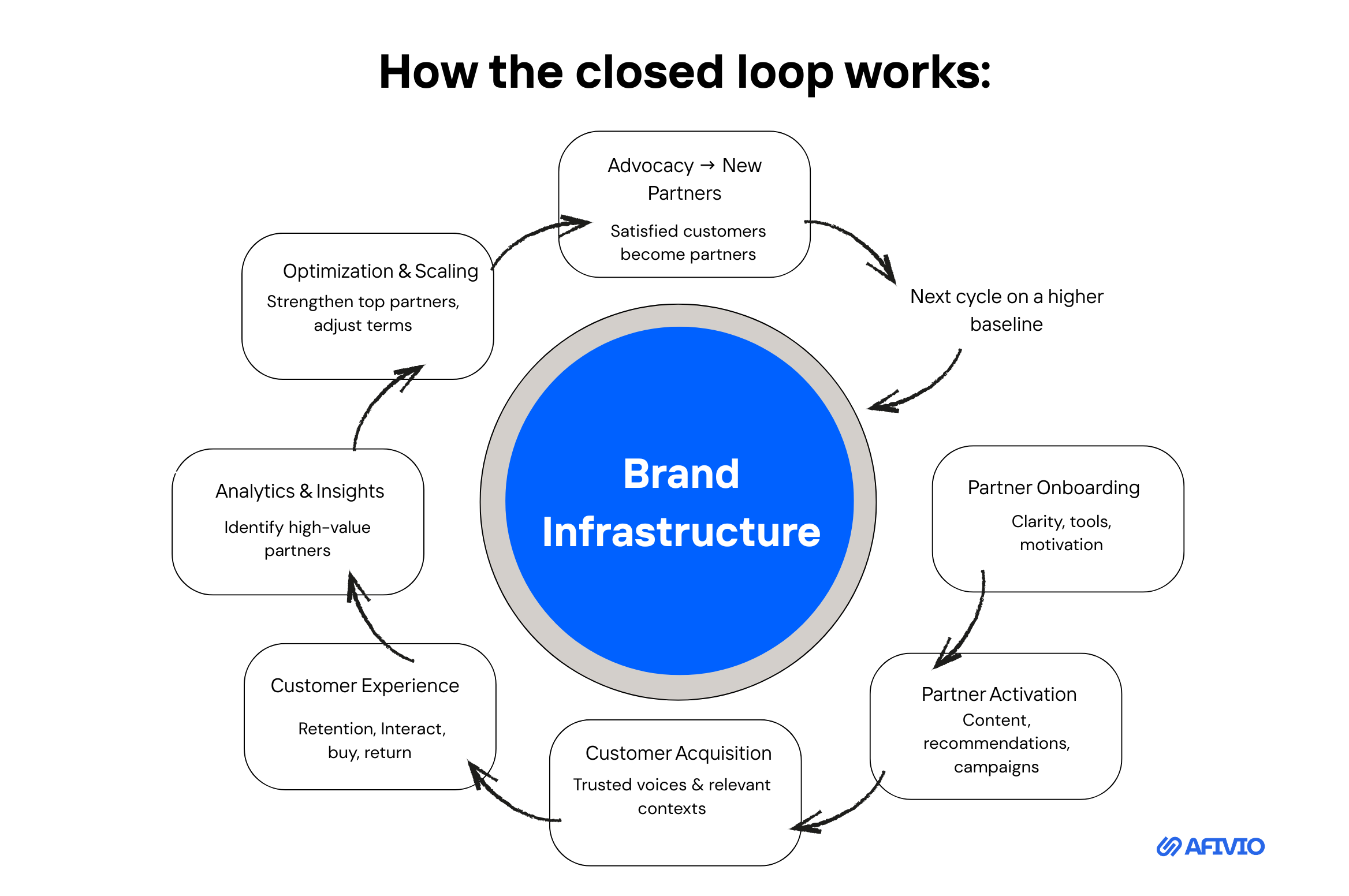
The crucial point: this closed loop is owned by the brand. It does not fully depend on changing algorithms or volatile auction prices.
The Brand as the Ecosystem Core: Control, Platform, Trust
Owning the Rules of the Game
For the loop to work, the brand must stop acting as “just an advertiser” and become the core of its own platform. In its own ecosystem, the brand independently defines:
- reward models: CPA, RevShare, hybrid, bonuses for audience quality, LTV or repeat purchases;
- traffic requirements: allowed sources, communication formats, restrictions for sensitive categories;
- transparency standards: documented conditions, payout SLAs, anti-fraud policies.
This shifts the dynamic from adapting to someone else’s platform to providing clear, fair, predictable conditions where partners are willing to invest their time, effort, and reputation.
A Single Technology Platform as the Operating System
Without technology, any growing partner network quickly turns into chaos. A unified platform:
- consolidates tracking of clicks, leads, sales, and events in one place;
- supports different terms for different partner segments;
- automates calculations and payouts, including multi-currency and compliance specifics;
- gives marketing, finance, and leadership a single source of truth for the partnership channel.
Solutions like Afivio are not just “click counters”; they serve as the operational backbone for a full-scale partnership ecosystem.
Reputation and Trust as a Magnet for Top Partners
Reliable partners choose brands that enable long-term collaboration. When a brand demonstrates predictable payouts, transparent rules, and responsive support, it moves to the top of the list for leading publishers, creators, and communities. This creates positive selection: strong partners are drawn into your ecosystem, further amplifying the brand and attracting even more quality players.
Partners as a Growth Multiplier, Not Just “Outsourced Traffic”
In a partnership ecosystem, partners are not a black box that “drives traffic from somewhere.” They are co-creators of value.
Who Can Be Part of a Modern Partnership Ecosystem
- influencers and content creators building trust through their personal brand;
- niche media, blogs, newsletters, Telegram/Discord communities;
- cashback platforms, coupon and deal sites, loyalty services;
- comparison and review platforms helping users choose rationally;
- agencies integrating your product into broader marketing strategies;
- technology partners (CRM, fintech, SaaS, martech) that create bundled offerings;
- offline partners, event organizers, local communities, clubs.
Each segment can follow its own incentive model while remaining part of one coordinated system.
Why Partners Choose Brands with a Strong Ecosystem
For partners, a mature ecosystem is attractive because it offers clear, stable rates without hidden conditions, access to a live dashboard with real numbers instead of vague estimates, predictable on-time payouts, and responsive support with creatives, integration help, and optimization tips. As a result, the strongest partners concentrate their efforts around such brands.
How the Brand Controls Traffic Quality
A managed ecosystem gives the brand the tools not just to attract partners, but to maintain quality: partner verification and basic KYC, white- and blacklists, clear rules for allowed channels and formats, automated fraud monitoring and manual review of suspicious activity, and differentiated terms for consistently high-quality partners. Instead of constantly fighting the consequences, the brand systematically manages the environment and filters out risk.
Customers as the Primary Indicator of Ecosystem Performance
LTV, Retention, and Repeat Purchases Over One-Time Conversions
In a mature partnership model, the core KPI is not traffic volume but customer value generated through the ecosystem. The brand evaluates the partnership channel through customer lifetime value (LTV) by partner or source, repeat purchase and renewal rates, average order value and cross-sell / up-sell behavior, churn, and satisfaction. This makes it possible to invest more in partners who bring in high-quality, long-term customers instead of cheap but low-value traffic.
Customer Experience as Part of the Partnership Promise
Partners put their own reputation on the line when they recommend a brand. If the brand fails — complicated checkout, poor support, hidden conditions — everyone loses: the customer, the partner, and the brand. A strong partnership ecosystem is impossible without a strong customer experience. Smooth purchase flows, transparent policies, fast delivery or activation, and loyalty programs are the foundation that turns buyers into advocates.
Customer Feedback as a Continuous Improvement Engine
Behavioral and performance data help the brand identify partners who over-promise or use misleading communication, understand which messages and offers resonate best, and refine creatives and landing pages to reflect real expectations. This turns the closed loop into a living optimization system.
Key Advantages of a Proprietary Partnership Ecosystem
- Predictable, controllable ROI. The brand sees the entire funnel and can adjust rates, budgets, and partner portfolios based on real performance instead of guesswork.
- Reduced dependency on paid platforms. The ecosystem does not replace paid media entirely but turns it from a single point of failure into one of several levers.
- Scalable growth without operational chaos. A unified platform and standardized workflows allow brands to onboard dozens or hundreds of partners without losing control.
- Long-term partner relationships. Instead of one-off deals, brands build multi-year strategic collaborations with mutual accountability and shared goals.
- Authentic recommendations that drive trust. Content from real people, experts, and communities converts better and strengthens brand equity.
- Single source of truth in analytics. Consolidated data on clicks, sales, LTV, geography, segments, and partner performance enables fast, confident decisions.
Common Mistakes When Building an Ecosystem
- No unified platform. Running partners through Excel sheets, chats, and scattered trackers inevitably leads to errors, mistrust, and leakage.
- Unclear or unstable partner terms. If rules change unpredictably or are not formalized, strong partners will simply leave.
- Lack of communication and support. A partnership ecosystem requires onboarding, education, regular updates, and two-way communication.
- Weak fraud management. Without proper controls, brands overpay for fake activity or expose themselves to reputational and legal risks.
- Short-term expectations. Expecting a “quick win” instead of treating the ecosystem as a capital investment that compounds over time undermines its potential.
A structured approach — supported by platforms like Afivio — helps avoid these pitfalls and build a scalable model from day one.
How Afivio Enables the Closed Partnership Loop
Afivio acts as the operational core of your partnership ecosystem. The platform allows brands to manage all partner types in one interface — affiliate sites, influencers, ambassadors, referral programs, communities, and more; configure flexible reward models and rules for each segment; track clicks, leads, sales, and repeat purchases transparently; and see the full customer journey and understand how the closed loop works in their specific business. In other words, Afivio is built to help brands not just “have an affiliate program” but own a strategic partnership ecosystem.
Real-World Scenarios: How Ecosystems Work Across Verticals
- eCommerce / D2C. Influencers, niche blogs, cashback services, and partner newsletters operate within a unified framework that reveals who brings customers with the highest LTV instead of discount-driven one-timers.
- Fintech / Banking / Cashback. Banks and fintech products build networks of review sites, financial bloggers, comparison tools, and partner marketplaces, where precise attribution, fraud protection, and compliance are critical.
- SaaS & Subscription Services. Agencies, integration partners, education platforms, and experts work on RevShare models that align their revenue with long-term customer retention.
- Marketplaces. Partners help attract both sellers and buyers, while a unified platform tracks which partners strengthen which side of the marketplace and enables tailored incentives for each segment.
Conclusion: A Partnership Ecosystem as a Strategic Brand Asset
A proprietary partnership ecosystem is not a buzzword and not “just another channel to test.” It’s a way to step out of the role of being hostage to ad auctions and become the owner of a closed, self-reinforcing growth loop.
The brand sets the rules. Partners amplify the brand’s voice. Customers receive real value that meets or exceeds expectations. The best of those customers return as partners, creators, and advocates.
This is how a resilient model emerges — powered not by sporadic campaigns, but by system design, trust, and data. If you’re ready to move your partnership efforts from ad hoc experiments to a strategic growth engine, Afivio is made to turn that closed loop “Brand → Partners → Customers → Brand” into something you can design, measure, and scale.